I · Physis — Nature
THE GREAT WAVE — AFTER HOKUSAI
Ithaka
C. P. Cavafy, “Ithaka”, 1911
The wave carries the journey. The geometry is Hokusai's sea; the text, the road we wish to be long.
ApproachHelix Codex · fourteen works on paper, in two series
Every sheet in this room holds a real text — a poem, a myth, a line of philosophy — written into the line itself. Photograph the print and the words come back, letter for letter.
Scroll to walk through the room
I · Physis — Nature
THE GREAT WAVE — AFTER HOKUSAI
C. P. Cavafy, “Ithaka”, 1911
The wave carries the journey. The geometry is Hokusai's sea; the text, the road we wish to be long.
ApproachI · Physis — Nature
LOGARITHMIC SPIRAL
Theodoros Dimitriou
A logarithmic spiral grows without changing shape: you move away and remain the same. The biography is not written on this page — it is hidden inside the work, like everything else here.
ApproachI · Physis — Nature
BRAIDED RIVERBEDS
Heraclitus of Ephesus, fragments
You cannot step into the same river twice. The drawing braids riverbeds that part and rejoin — and the text inside them says exactly that.
ApproachI · Physis — Nature
GOLDEN-ANGLE PHYLLOTAXIS
Phyllotaxis — an observation, not a quotation
The drawing is built from the very angle the text describes. The form is its own explanation.
ApproachI · Physis — Nature
RIDGES IN DEPTH
Folk song, traditional
Mountain ranges in depth, and inside them the voice that sang them before there was a way to write it down.
ApproachI · Physis — Nature
PETALS IN THREE LAYERS
Sappho, fragments 47 and 168B
Petals in three layers. The oldest text in the series, in its simplest geometry.
ApproachI · Physis — Nature
CONCENTRIC RINGS WITH A GATE
Apollodorus, Library III
The thread is the very line you are reading. The labyrinth hides the story of the labyrinth, and the way out is to follow it.
ApproachII · Archai — First principles
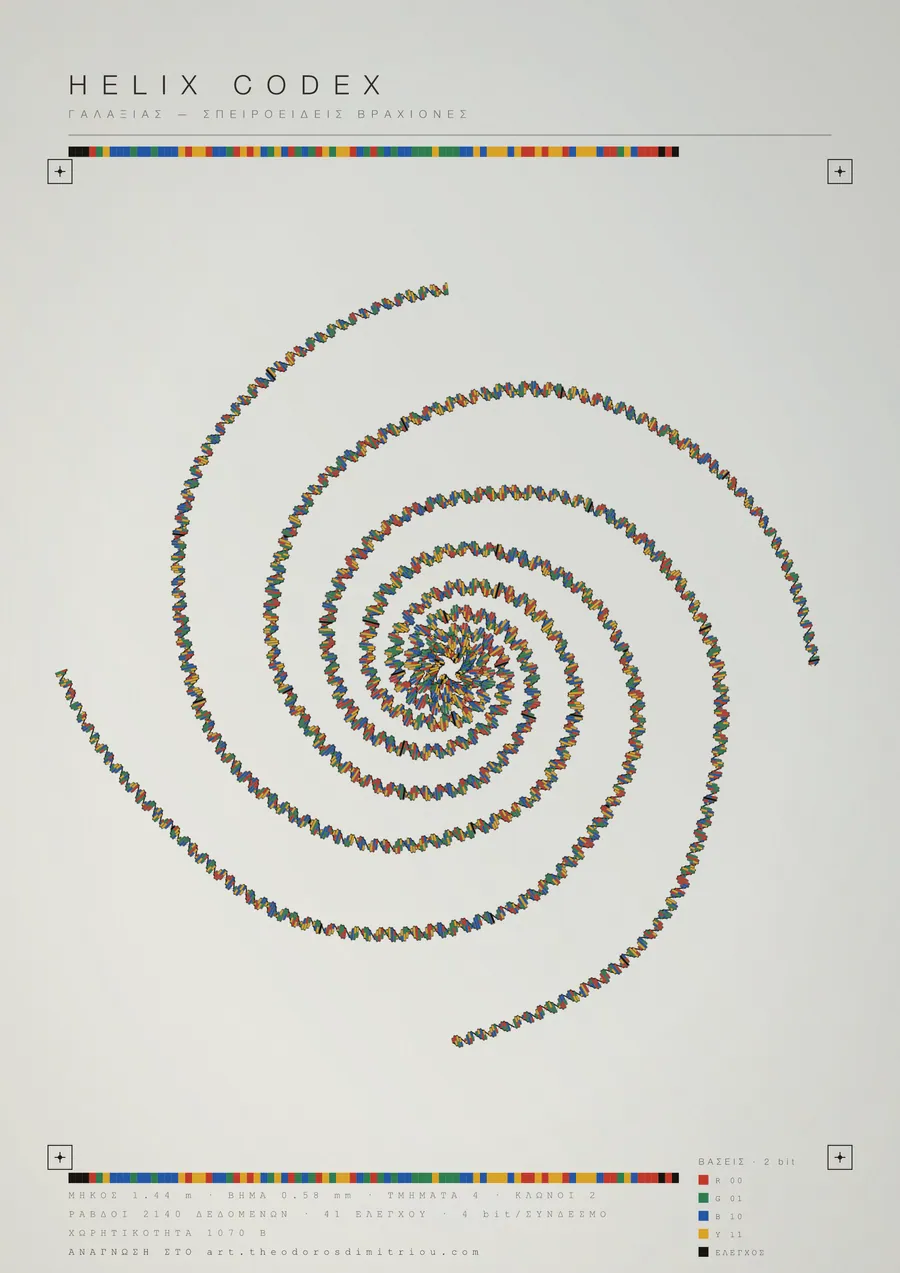
SPIRAL ARMS
Plato, Theaetetus 155d · Aristotle, Metaphysics 982b
Aristotle says where wonder looked first: the moon, the sun, the stars, the beginning of the whole. A galaxy is its shape — and philosophy, says Plato, has no other beginning.
ApproachII · Archai — First principles
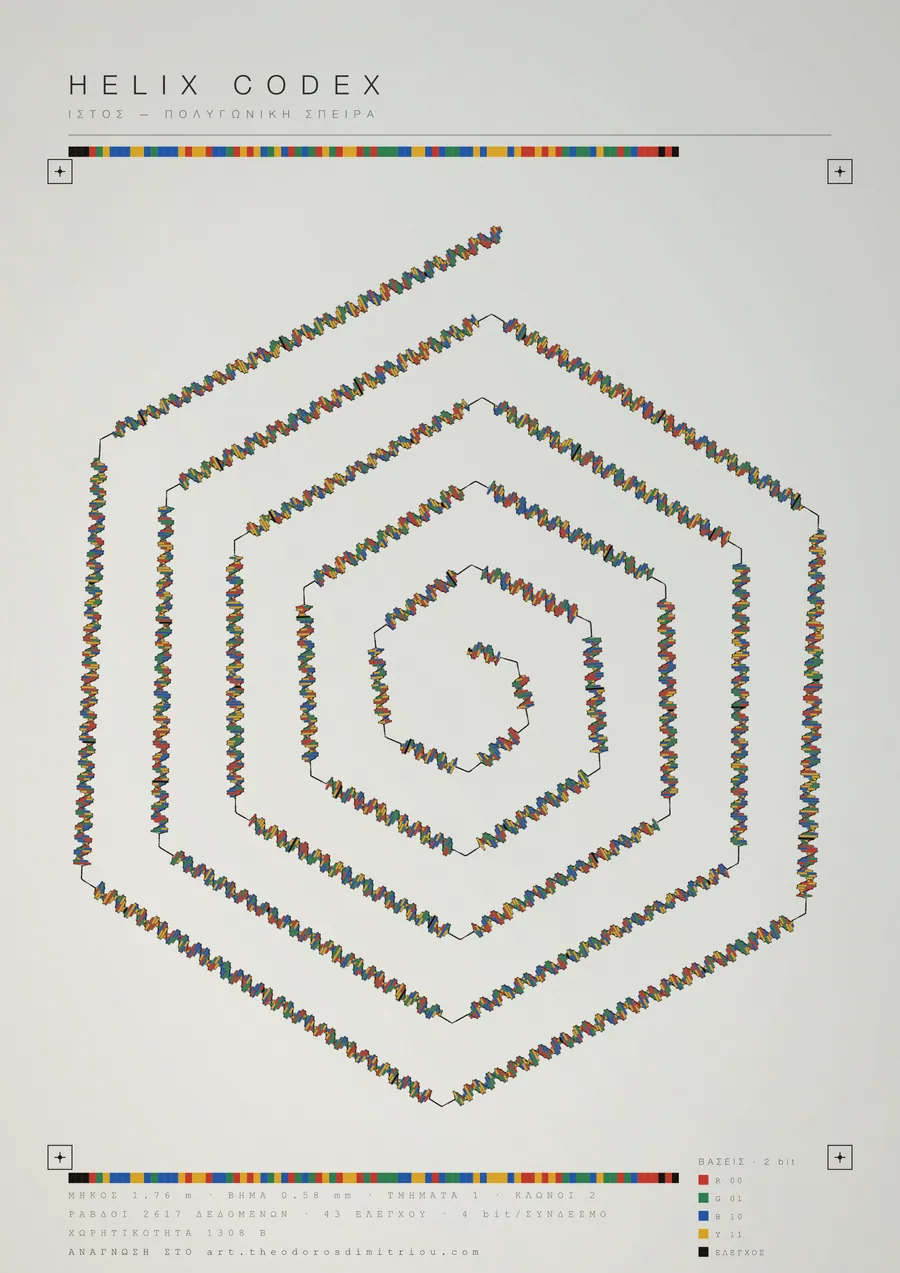
POLYGONAL SPIRAL
Anaximander of Miletus, fragment 1 (Simplicius)
One of the oldest surviving sentences of philosophy is about justice: things pay one another back what they owe, in the order of time. The polygonal spiral turns by the same angle at every corner — the plainest picture of fairness.
ApproachII · Archai — First principles
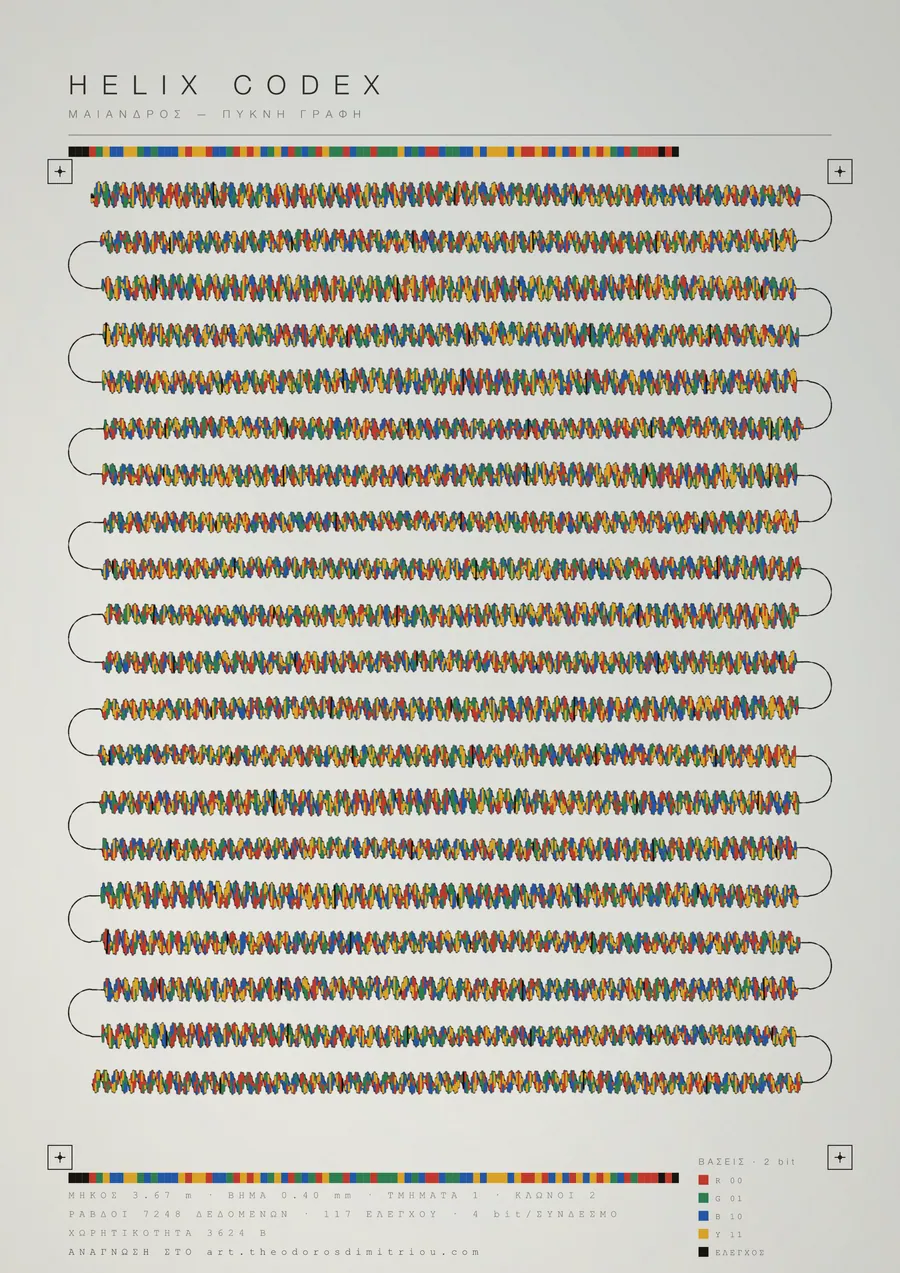
DENSE SCRIPT
Heraclitus of Ephesus, fragments 1 and 50
Line after line, like a page the logos writes itself. Heraclitus says people fail to understand it both before and after hearing it — they overlook what they do awake, as they forget what they do asleep. Here it lies in front of your eyes.
ApproachII · Archai — First principles
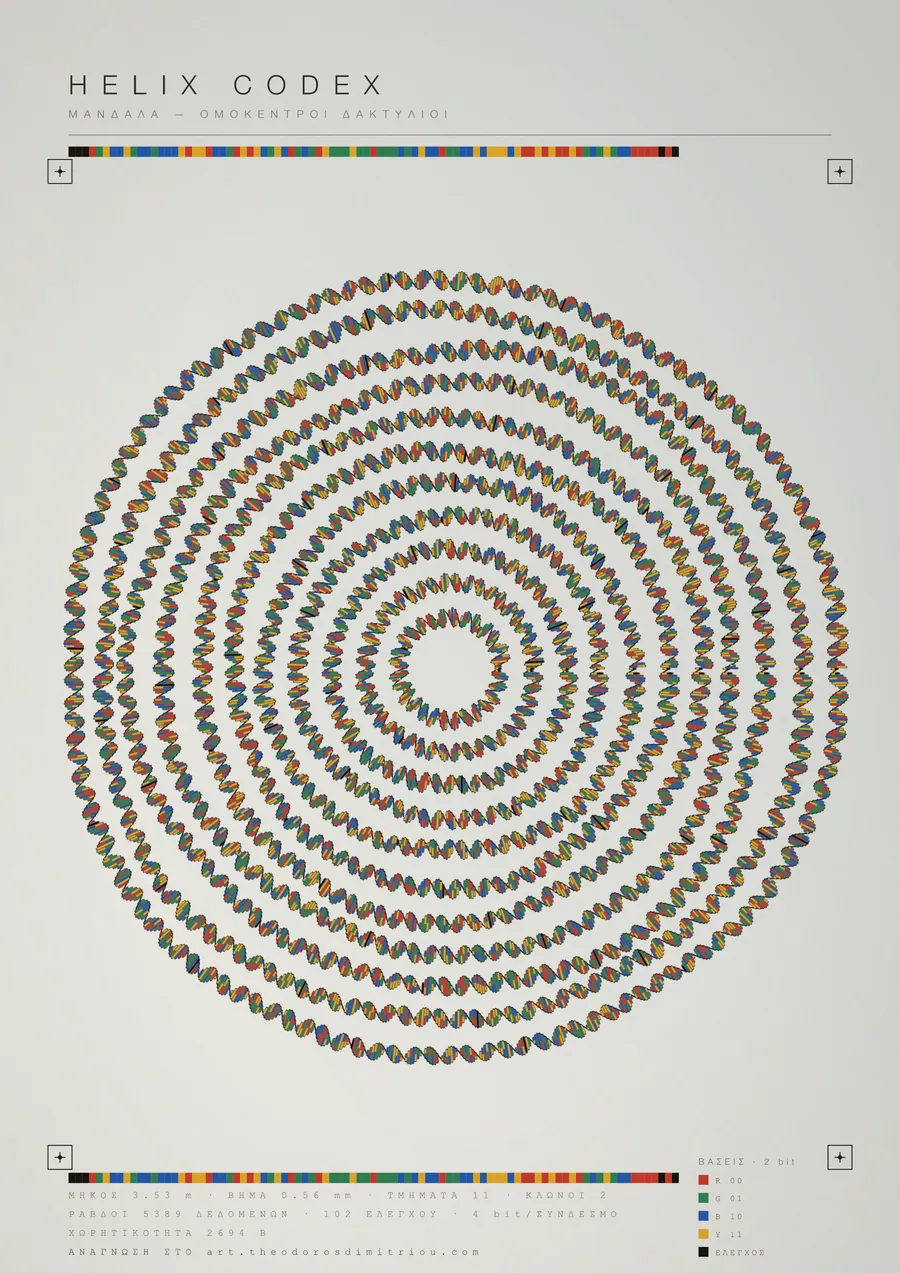
CONCENTRIC RINGS
Parmenides of Elea, fragments 3 and 8
Parmenides' sphere, cut through the middle: the same from the centre in every direction. Being is neither greater nor smaller here or there — so the rings have no beginning and no end.
ApproachII · Archai — First principles
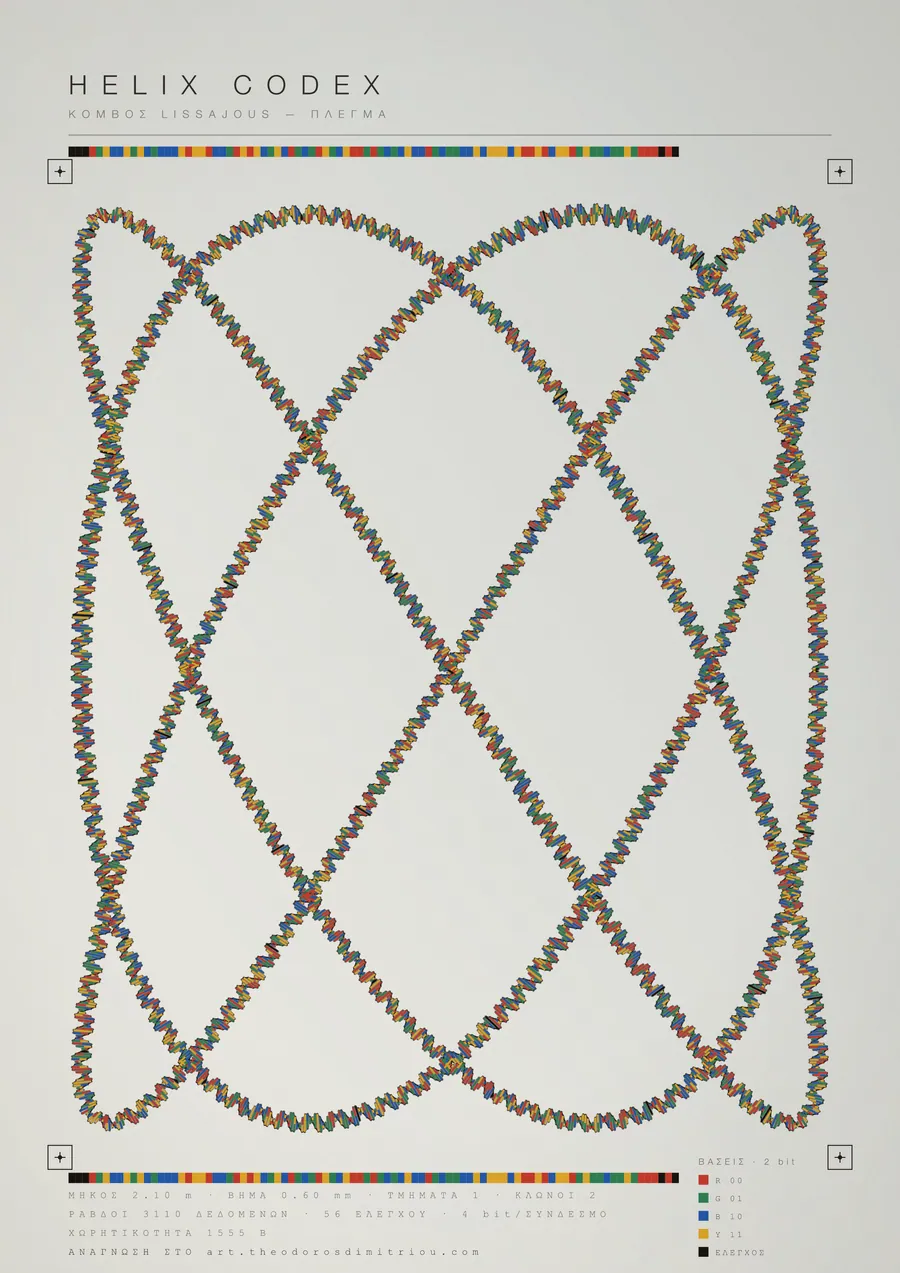
LISSAJOUS WEAVE
Empedocles of Acragas, fragment 17
One line that meets itself and parts again. What Love joins, Strife undoes, and the whole begins again — one knot, tied and untied for ever.
ApproachII · Archai — First principles
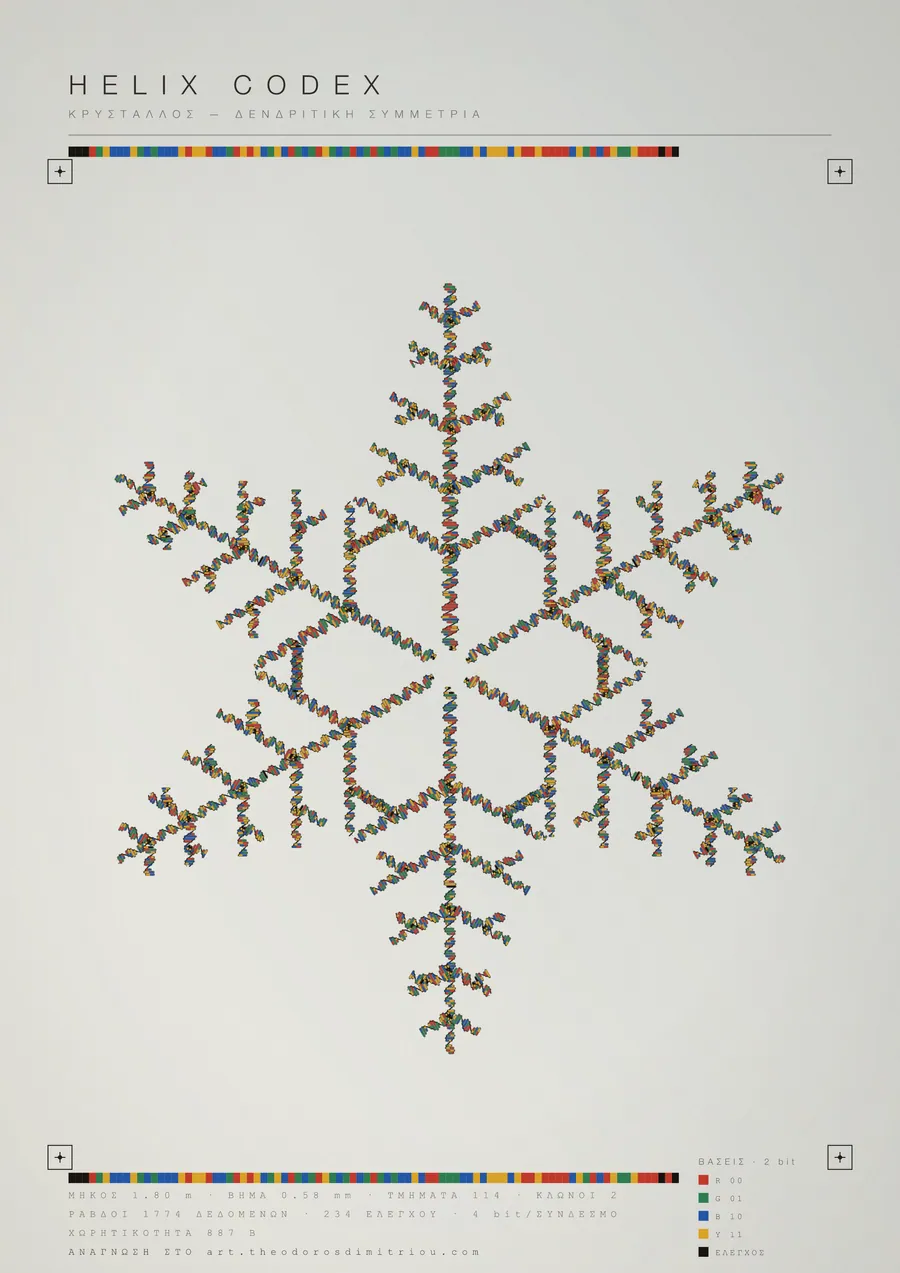
DENDRITIC SYMMETRY
Democritus of Abdera, fragment 9
A crystal is the nearest thing we have to Democritus' vision: order made of atoms and void. Colour, he says, exists only by convention — and here colour is, quite literally, the alphabet.
ApproachII · Archai — First principles
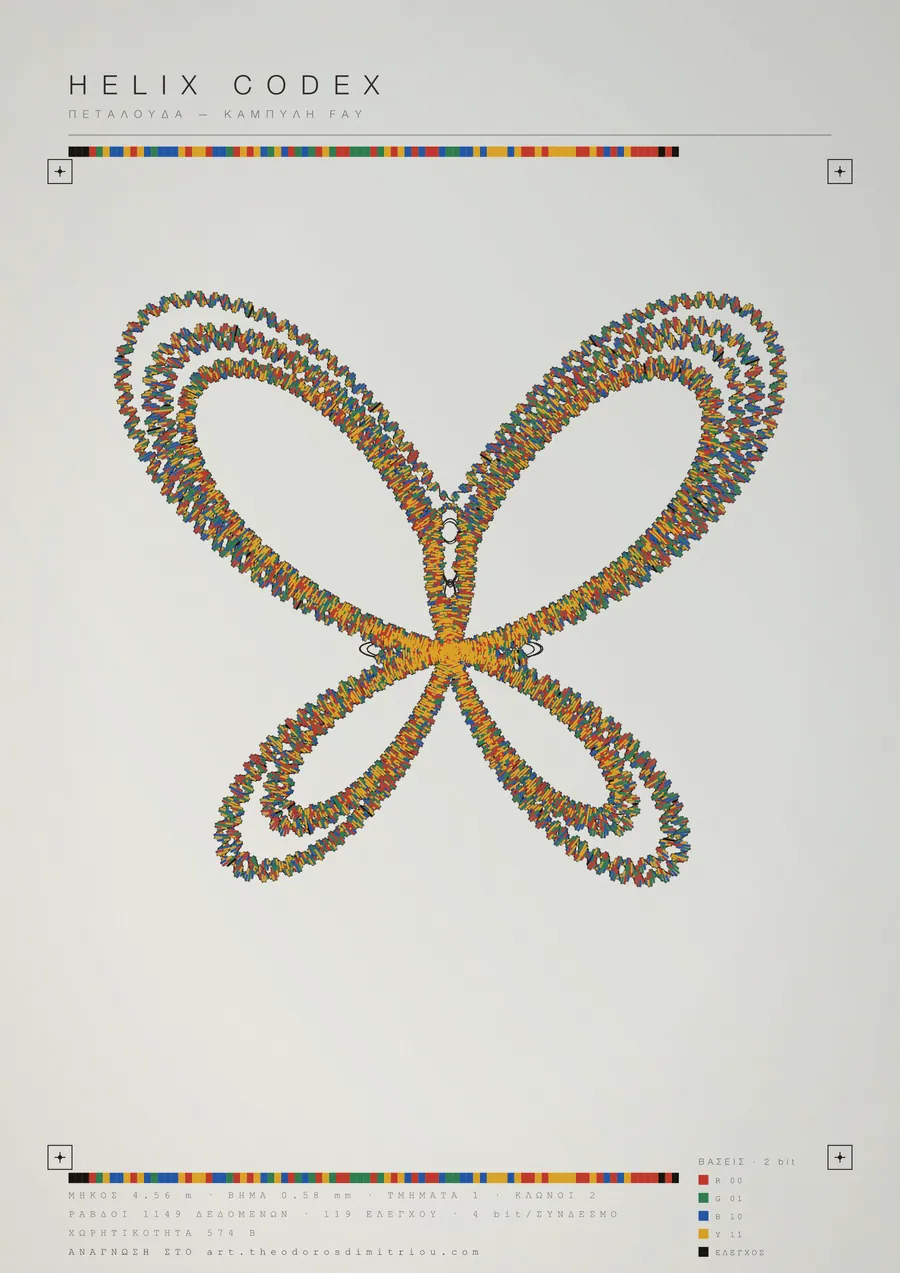
FAY'S CURVE
Plato, Phaedrus 245c
In Greek, psyche means both soul and butterfly. Plato calls it the beginning of motion: what moves itself.
ApproachThree distances
A form. A wave, a spiral, a labyrinth — geometry drawn by equations, never by hand.
All worksWriting. The line is a double helix and every rung carries a colour. Come down to 0.4 mm and you are looking at the atoms of the letters.
WorksThe text. Photograph the whole sheet with the reader and the hidden words return, intact — no account, no network, no key but the page itself.
How to read a work14 works
Series I
Seven forms from nature and myth — wave, spiral, river, sunflower, mountains, flower, labyrinth. In each, the text belongs to the form that hides it.
The paper
A4 is 1 : √2. Cut it in half and you get two copies of itself. The ancients called √2 ἄλογον — without ratio, unspeakable — and here it carries spoken words. That contradiction is the whole subject.
Why the paper is irrationalAcquire

Archival pigment prints on matte cotton paper, signed and numbered. The larger the sheet, the more easily the reader reads it.
Sizes and pricesYour text — vows, a poem, a family history, a founding charter — set into a geometry we choose together. The words go inside the work, not beside it.
Commission a pieceThe reader
It runs on any phone, offline, without an account. It finds the four corner marks, straightens the photo, calibrates colour from the legend, follows the helix and repairs what the camera got wrong.
From five to fourteen I drew and painted. Then computers came and I put the brush down. These works are the road I found back — without leaving behind what I learned in between.
The story